
Moissanite vs Lab-Created Diamond: Which Is Right for You?
Choosing between a moissanite vs lab-created diamond is one of the most genuinely confusing decisions couples face when shopping for an engagement ring. Both stones look stunning in photographs, both cost a fraction of a mined diamond, and both carry strong ethical credentials. Yet they are fundamentally different materials with different optical personalities, different long-term resale considerations, and different price points. If you walk into a consultation at Livia Diamonds without knowing these differences, you may end up with a stone that doesn't match what you pictured, or one that doesn't suit how your partner wears jewelry day-to-day. This guide gives you a clear, direct answer, not a hedge.
Table of Contents
- What Makes Moissanite and Lab Diamonds Different
- Quick Takeaways
- Brilliance and Fire: The Real Visual Difference
- Durability and Everyday Wearability
- Price Comparison: Moissanite vs Lab Diamond
- Ethical and Environmental Considerations
- Which Stone Suits Which Buyer
- Side-by-Side Comparison
- Frequently Asked Questions
- References
What Makes Moissanite and Lab Diamonds Different
The single most important fact to understand is that moissanite and lab-created diamonds are not the same material. Moissanite is composed of silicon carbide, while lab-grown diamonds, like their mined counterparts, are composed of pure carbon atoms arranged in a crystalline structure. Some jewelers blur this distinction by using the term "moissanite diamonds," which creates unnecessary confusion for buyers.
Because they are different materials, they behave differently under light, on the Mohs hardness scale, and in how they are graded. Understanding the chemistry is not just academic: it directly affects what your ring looks like on the hand and how it holds up over decades of daily wear.
Lab-created diamonds are grown in a controlled laboratory environment using either High Pressure High Temperature (HPHT) or Chemical Vapor Deposition (CVD) processes. The end result is a stone that is physically, chemically, and optically identical to a mined diamond. Moissanite, on the other hand, was originally discovered in a meteorite crater and is now produced in laboratories specifically as a diamond alternative.
Quick Takeaways
Key Insight |
Explanation |
|---|---|
Different materials entirely |
Moissanite is silicon carbide; lab diamonds are carbon. They are not interchangeable terms. |
Moissanite has more fire |
Its higher refractive index produces colorful, rainbow-like flashes that some love and others find too flashy. |
Lab diamonds score higher on hardness |
Diamonds rate 10 on the Mohs scale; moissanite rates 9.25 to 9.5. Both are highly scratch-resistant for daily wear. |
Moissanite costs significantly less |
For the same carat weight appearance, moissanite is a fraction of the price of a lab-grown diamond. |
Lab diamonds are graded like mined diamonds |
They receive GIA or IGI certifications for cut, color, clarity, and carat. Moissanite uses its own grading system. |
Both are ethical alternatives |
Neither requires mining, which appeals to couples prioritizing sustainability and supply chain transparency. |
Your lifestyle matters more than marketing |
Active, hands-on wearers may prioritize durability; budget-conscious buyers may prefer moissanite's price advantage. |
Before diving into the specific properties of each stone, it helps to understand that neither option is objectively superior. The right choice depends entirely on which qualities matter most to you and your partner. That said, there are clear situations where one outperforms the other, and this guide will call them out directly.
Brilliance and Fire: The Real Visual Difference
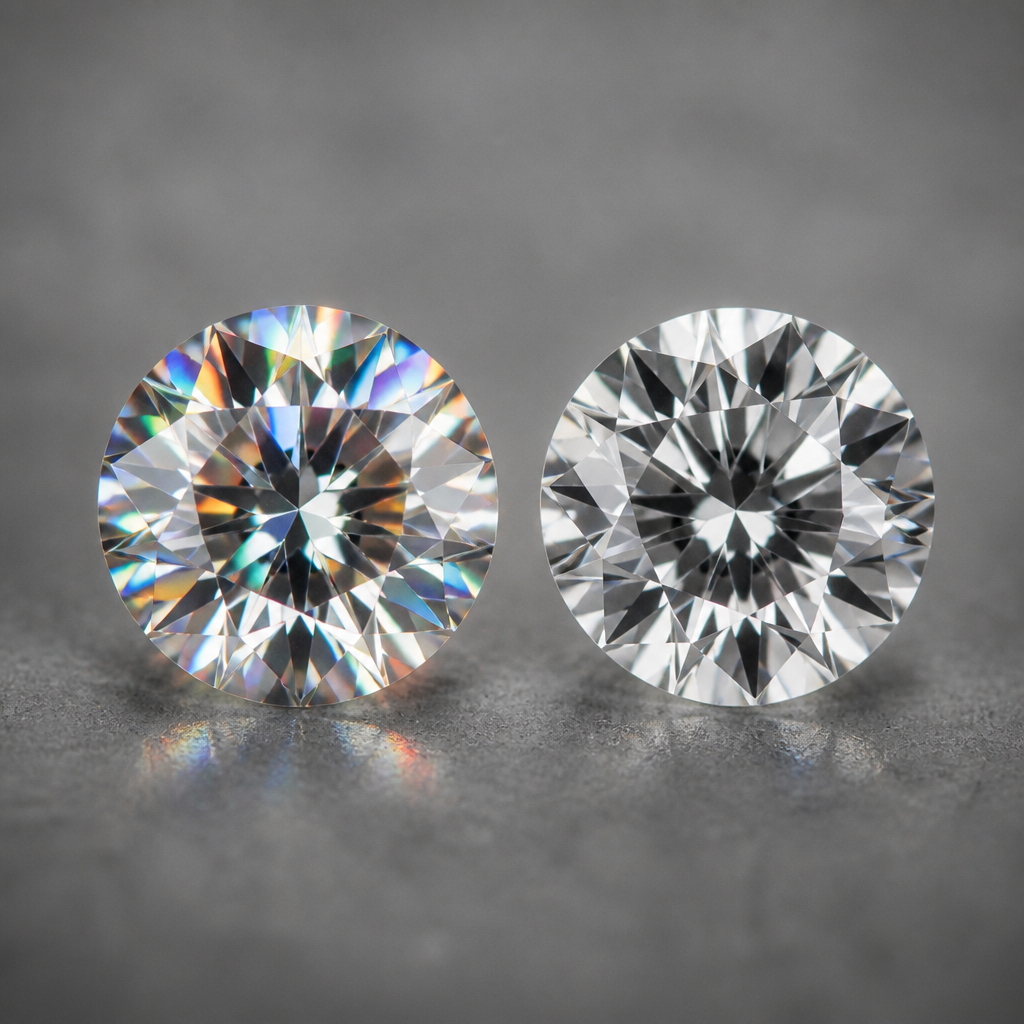
This is where the two stones diverge most visibly, and it is the detail that most buyers overlook until they see both stones side by side in person. Moissanite is famous for its colorful, rainbow-like flashes of light, technically called "fire." This is a result of its higher dispersion rate compared to diamond. In bright sunlight or under intense lighting, moissanite produces a disco-ball effect that is striking and unmistakable.
Lab-created diamonds produce brilliance (white light reflection) and fire (colored light dispersion) in proportions that match a mined diamond. The sparkle is bright and clean rather than spectral. For people who want a ring that reads as a traditional diamond, the lab-grown option is the more accurate visual match.
When the Fire of Moissanite Works in Your Favor
If your partner loves statement jewelry, gravitates toward maximalist aesthetics, or simply wants the most sparkle per dollar, moissanite delivers. In lower carat weights, the rainbow fire is less pronounced and more balanced. Many people find moissanite in sizes under 1.5 carats visually indistinguishable from a diamond under normal lighting conditions.
When Lab Diamond Brilliance Is the Better Match
If your partner works in a professional environment where a very traditional-looking ring matters, or if they are the type to notice the difference and care about it, a lab diamond is the safer choice. It will not flash rainbow colors in board-meeting lighting. It will look exactly like what most people picture when they think of an engagement ring.
The optical difference between moissanite and lab diamond is not a flaw in either stone. It is simply a different personality. The mistake is choosing one without knowing which personality matches the person who will wear it every day.
Durability and Everyday Wearability
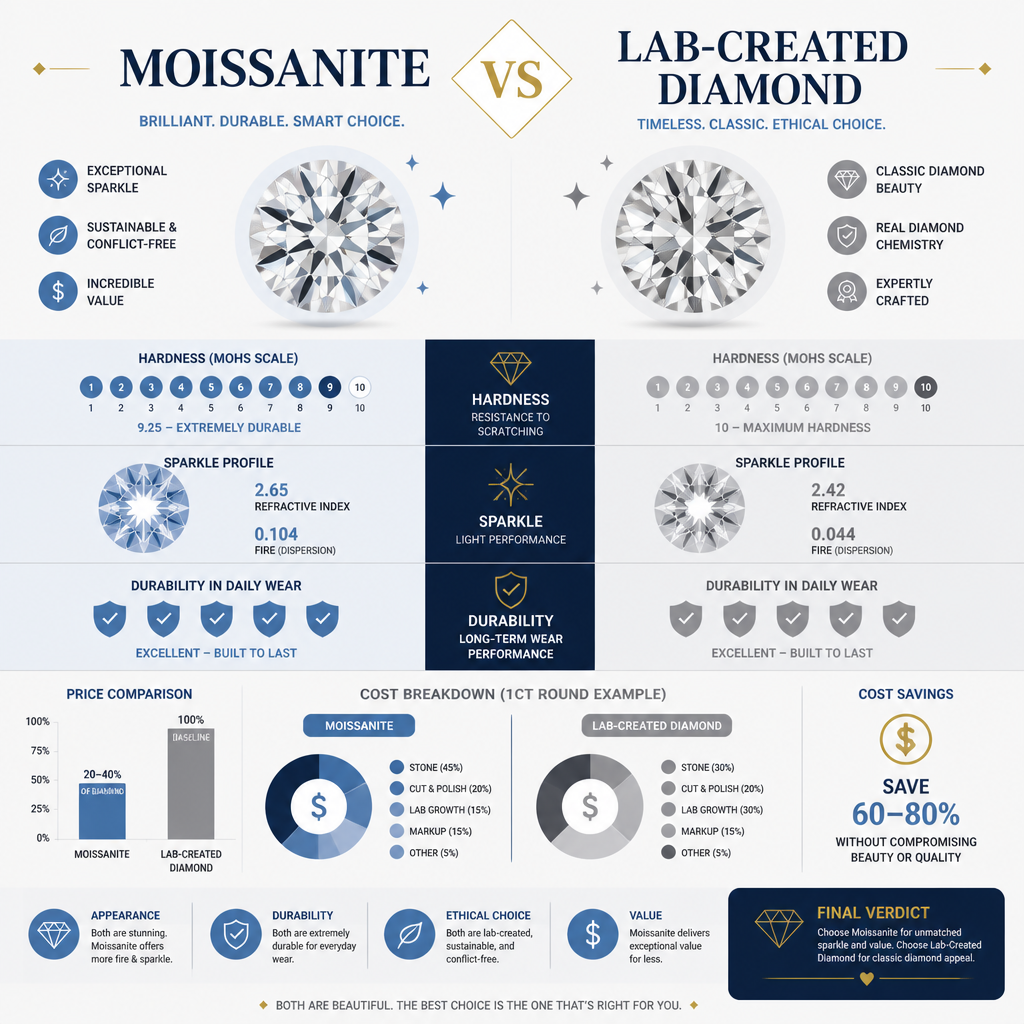
Both stones are exceptionally durable and suitable for daily wear as an engagement ring. On the Mohs hardness scale, diamonds score a perfect 10, making them the hardest natural material known. Moissanite scores between 9.25 and 9.5, which still places it well above most other gemstones including sapphire and ruby.
In practical terms, this means moissanite will resist scratching in virtually all normal daily activities. The difference between a 9.5 and a 10 on the Mohs scale is not something you will notice while cooking, typing, or working out. Both stones will outlast the setting they are mounted in.
Cleaning and Long-Term Maintenance
Both moissanite and lab diamond rings clean up easily with warm water, mild dish soap, and a soft brush. Neither stone is porous, so lotions, soaps, and perfumes do not damage the material itself. Over time, moissanite can develop a slight film from oil buildup more quickly than diamond due to differences in surface properties, but a routine cleaning every few weeks prevents this entirely.
Pro tip: If you're shopping at Livia Diamonds and comparing stone options, ask to see both under store lighting and then step outside into natural daylight. The fire difference between moissanite and lab diamond is far more apparent outdoors than under controlled indoor lighting.
Price Comparison: Moissanite vs Lab Diamond
Price is where moissanite wins decisively, and there is no need to soften that statement. A moissanite stone of a given carat weight will cost significantly less than a lab-grown diamond of the same size and quality. For couples working with a defined budget, this gap translates directly into the ability to choose a larger stone, a more elaborate setting, or both.
Lab-grown diamonds themselves are already substantially more affordable than mined diamonds of equivalent quality. So the price ladder from most to least expensive runs: mined diamond, lab-grown diamond, moissanite. Each step down represents a meaningful saving without a meaningful sacrifice in visual quality for most buyers.
What the Price Difference Actually Buys You
At Livia Diamonds, the budget you would spend on a 1-carat lab-grown diamond could get you a significantly larger moissanite center stone in the same setting style. If stone size is a priority and budget is a constraint, moissanite gives you more visual impact per dollar. If you want a stone that is certified by the same grading labs (GIA or IGI) as a mined diamond and carries that designation on paper, the lab diamond is worth the premium.
Pro tip: When comparing prices online, watch for the distinction between "carat weight" and "carat weight equivalent." Moissanite is lighter than diamond by density, so sellers often list it by millimeter size or diamond equivalent weight rather than actual carat weight. Always confirm which measurement you're comparing to avoid a misleading price-per-carat calculation.
Ethical and Environmental Considerations
Both moissanite and lab-created diamonds sidestep the ethical concerns that have long been associated with mined diamonds: conflict financing, unsafe labor conditions, and significant land disruption. For couples who want a ring that reflects their values as much as their aesthetic, both options are defensible choices.
The distinction between the two on ethical grounds is minor. Lab-grown diamonds require significant energy to produce, though many producers are moving toward renewable energy sources. Moissanite production also requires laboratory energy input but generally uses fewer resources to produce the same visual result. Neither option involves child labor, conflict zones, or the environmental footprint of open-pit diamond mining.
Transparency and Traceability
One underappreciated advantage of both options is traceability. You can know exactly where your stone came from, which is something the mined diamond industry has historically struggled to guarantee despite certification programs. At Livia Diamonds, both moissanite and lab-grown diamond engagement rings come with full transparency about their origin, which matters to a growing segment of buyers who research the supply chain before committing to a purchase.
The demand for sustainable jewelry alternatives has grown substantially among younger couples, driven by greater awareness of moissanite's and lab diamond's ethical advantages and the rise of direct-to-consumer e-commerce that makes these options more accessible than they were even five years ago.
Which Stone Suits Which Buyer
Rather than hedging, here is a direct recommendation based on buyer profile. If you are shopping for a moissanite engagement ring, you are likely prioritizing maximum size and sparkle for your budget, and you are comfortable with a stone that has its own distinct optical character rather than mimicking a diamond exactly. Moissanite buyers tend to be confident in their choice and often actively prefer that their ring stand out from a traditional look.
If you are shopping for a lab-grown diamond ring, you likely want the cultural and emotional weight that comes with the word "diamond," the familiar certification system, and a stone that reads as a classic diamond to anyone who looks at it. Lab diamond buyers often want the ethical benefits of a non-mined stone without any visual trade-off from the traditional diamond aesthetic.
A Common Mistake to Avoid
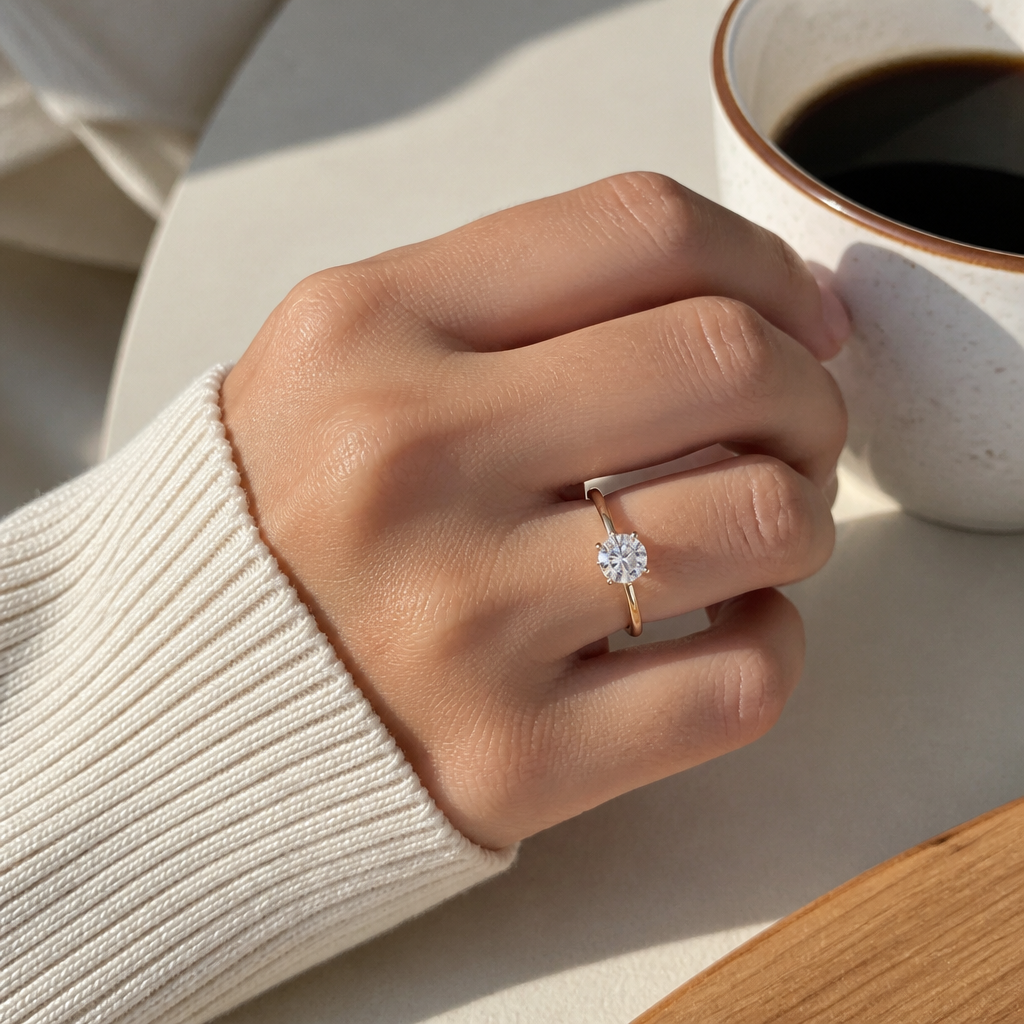
The most common mistake buyers make is choosing a stone based on price alone without accounting for how the stone will look on the specific hand and in the specific setting style they want. A large moissanite in a delicate solitaire setting will show its fire prominently. A smaller moissanite in a pavé halo setting will blend more seamlessly with the surrounding accent stones. The setting you choose amplifies or moderates the stone's visual character, so consider both decisions together.
Side-by-Side Comparison
Property |
Moissanite |
Lab-Created Diamond |
|---|---|---|
Chemical composition |
Silicon carbide (SiC) |
Pure carbon (C) |
Mohs hardness |
9.25 to 9.5 |
10 |
Optical character |
High fire, colorful rainbow flashes |
Balanced brilliance and fire, classic diamond sparkle |
Price point |
Lowest of the three (mined, lab, moissanite) |
Higher than moissanite, lower than mined diamond |
Certification |
Own grading system, not GIA/IGI certified as diamond |
GIA, IGI certification available, same as mined diamond |
Origin |
Lab-created (originally found in meteorites) |
Lab-created via HPHT or CVD process |
Ethical profile |
Conflict-free, no mining required |
Conflict-free, no mining required |
Best for |
Maximum size and sparkle on a budget |
Traditional diamond look with ethical sourcing |
Frequently Asked Questions
Is moissanite a fake diamond?
No. Moissanite is a real gemstone with its own distinct chemical identity: silicon carbide. It is not a diamond simulant in the sense of being a cheap imitation. It is a different material that happens to share many visual properties with diamond. Calling it "fake" is as inaccurate as calling a sapphire a fake diamond. Lab-created diamonds, on the other hand, are real diamonds in every scientific sense of the word.
Can a jeweler tell the difference between moissanite and a lab diamond?
Yes, a trained gemologist can distinguish them using a thermal conductivity probe or a moissanite-specific tester, and under magnification the optical properties are detectably different. However, to the naked eye of an everyday observer, the two stones are very difficult to tell apart in most lighting conditions and ring sizes under about 2 carats.
Does moissanite hold its value?
Moissanite does not have a secondary market that commands significant resale value, and neither do lab-grown diamonds at the moment. If resale value is a priority, neither option is a strong investment vehicle. However, if the goal is a beautiful, durable ring that you intend to wear and keep rather than sell, resale value is largely irrelevant to the purchase decision.
Which stone is better for an active lifestyle?
Both are highly suitable for active wearers. The practical difference in scratch resistance between a Mohs 9.5 (moissanite) and a Mohs 10 (diamond) is negligible for the activities most people engage in daily. Neither stone will scratch from contact with metals, kitchen surfaces, or gym equipment. If you work in an environment with industrial abrasives, a diamond edge is technically more protective, but for the vast majority of people, moissanite's hardness is more than sufficient.
Can I get a moissanite or lab diamond in any ring style at Livia Diamonds?
Yes. Livia Diamonds offers both moissanite and lab-created diamond center stones across a wide range of settings, cuts, and band styles. Whether you prefer a classic solitaire, a pavé halo, a three-stone design, or a custom creation, both stone types can be set in your chosen metal and style. The team also offers virtual and in-person consultations to help you compare stones side by side before committing.
Which stone should I choose if my partner hasn't seen either in person?
Book a consultation first. This is the single most useful step you can take before making a final decision. Seeing moissanite and lab diamond side by side under different lighting conditions resolves most of the uncertainty that online research creates. Livia Diamonds offers both in-person and virtual consultations specifically designed for buyers in exactly this situation. A photograph will not tell you how a stone behaves in natural light on an actual hand.
Have you recently compared moissanite and lab-created diamond rings in person? We'd love to hear what surprised you most about the experience.